Tuesday, 10 March 2015

Circulation & Authorship of the Photo-image

Authorship refers to the person who has ownership of an image
Circulation (in modern times) can be sharing images on social media, e.g. Facebook, Instagram, and Flickr. Using Instagram as a case study, the social network allows its users to easily circulate their own pictures. Accounts which aren’t private can be seen by users across the world. The use of filters allows all users to use someone else’s artistic vision which questions  the concept of authorship. However Instagram users still have ownership over their photos.


Analog to Digital: The Indexical Function of Photographic Images

McLuhan: “the message of any medium or technology is the change of scale or pace or pattern that it introduces into human affairs”. For example, the railway did not introduce movement or transportation into human society, but it did create new types of cities and accelerated human movement. Digital technology has allowed for editing, because rather than being an object (analog), the photograph is data. Digital technology “challenges the the historical belief that photography is representative of reality”

Analog Photography: “Light bounces off an object and is recorded in the silver salts of the film’s emulsion”
Barthes: “photographic referent” is the object that is in front of the lens, needed to record its image

Digital Photography: Translated into code, so lacks a physical connection between the subject and the image. Doubting “the reliability of photography’s connection to the real”. “Certainly subjects have been told to smile, photographs have been staged, and other such manipulations…but now the viewer must question the photograph at the basic level.”


Richard Hamilton
  • Born in 1922 in London, died in 2011
  • Inspired by Eduardo Paolozzi and Marcel Duchamp
  • Pop Art
  • Popularised and recreated Duchamp’s work


“The Bride Stripped Bare by her Bachelors, Even” also called “The Large Glass”
(Duchamp’s work on the left, Hamilton’s recreation on the right). His work questions authorship since it's almost a direct copy of someone else's work. 

Julian Stallabrass
  • Art historian, photographer and curator from London, UK
  • Professor at Courtauld Institute of Art, University of London
  • Photographs people, places and sculptures usually in vernacular style
  • Uses photography as a social commentary to enforce his own ideologies


The image above was taken in Berlin. It denotes a graffiti portrait of Snow White wearing a bandana and holding a grenade. The text below is translated to ‘anti war’. By Stallabrass taking a photograph of this it is suggested that it reflects his own ideology that he too is against war. The studium of this photograph would be the graffiti in the centre of the image, however this was art created by someone other than Stallabrass. This questions his authorship as the very thing that attracts you to the photo was made by someone else.


This photograph was taken in Chingford, London. Stallabrass argues that taking things out of their context and constructing a more beautiful image is too conventional. He therefore prefers to capture the essence of the natural environment without tweaking too much. In terms of authorship, he considers lighting and composition when taking his pictures. “When photographing, I look for a combination of light, formal and symbolic juxtaposition that appears to work together and gives the subject coherence. Choices about framing, exposure and focus may help to bring that coherence out”.

Michael Wolf
  • German Artist & photographer 
  • Become a photojournalist working in Hong Kong in 1994
  • In 2003 he decided to only work on fine-art photography projects

The photograph above is from Wolf's series called 'Real Fake Art'. Wolf photographs regular people holding famous pieces of art. It could be argued that the punctum of the images are the pieces of art which is not his own work. However Wolf uses his own artistic values in terms of deciding on location, subjects, and lighting. In the image above, the setting looks quite deprived and the lighting is very low; this subsequently draws attention to the Pop Art painting. 


I think this topic as a whole is quite relevant to my project, since with taking pictures of shop windows, I will be showing someone else's creation in terms of the shop display. However, like Wolf I will make my own decisions in terms of lighting and create my own punctum that is different from the original creators vision.

Tuesday, 3 March 2015

Lighting Workshop

For this week's task we were working with the flash guns on the camera. This can be used to compensate for absence of light or to combat shadows.


I think that this picture worked well since there was a lot of natural sunlight coming from behind.


I then tried to use the flash gun in an area where there was less natural light. The flash gun worked well to illuminate the subject.


I think the image above worked well since the background was quite dark but the foreground was really bright.


In this image we again tried to work with an area that was quite dark. Here you can see that the natural light coming from the window slightly illuminates the subject. Furthermore the use of the flashgun brightened up the image as a whole.


When shooting inside many of the images appeared overexposed, even though the artificial lights were dim. Using the flash gun resulted in the images appearing blurry.

Cultural Imaginaries & Landscape Photography

This topic largely relates to photographers editing their photographs to create an imaginary landscape. Landscape photography was originally used to denote the background of a subject and there's usually an absence of human presence.

Victor Burgin - Thinking Photography: Photography, Phantasy, Function


"Art is a set of 'techniques' for upsetting routine perceptions of the world" - Schlovsky

I think this quote relates to this week's topic, since photographers take literal perceptions of landscapes and then subvert them to conform to their own artistic perceptions.

Rodchenko states that conventionally photography will create 'the navel photo' by taken a picture with their camera rested on their stomach facing directly straight ahead. Rodchenko argues that photographers should experiment with using all different angles and compositions. The cultural imaginaries topic encourages imagination and not necessarily painting a literal portrait of something.

Oktyabr photography - Supported the development of 'specifically photographic' formal structures without the influence of 'bourgeois culture'
ROPF - Supported swift and effective communication that could easily be understood by everyone

Burgin argues that neither of these concepts were 'post-revolutionary' and probably disagreed with these theories since they don't particularly encourage imagination. Contemporary works critique Oktyabr for defying conventions.

Further points from the reading:

  • Photography and classical painting both depend on 'camera obscura' - projecting light from 3D solid onto a plane surface. This conforms to geometric laws of light
  • Freud - psychological investment in looking - creating scopophilia. Men look whereas women are only looked at 
  • Burgin argues that there is never 'just-looking;' There is always context with subject
  • Shifts between voyeurism and narcissism

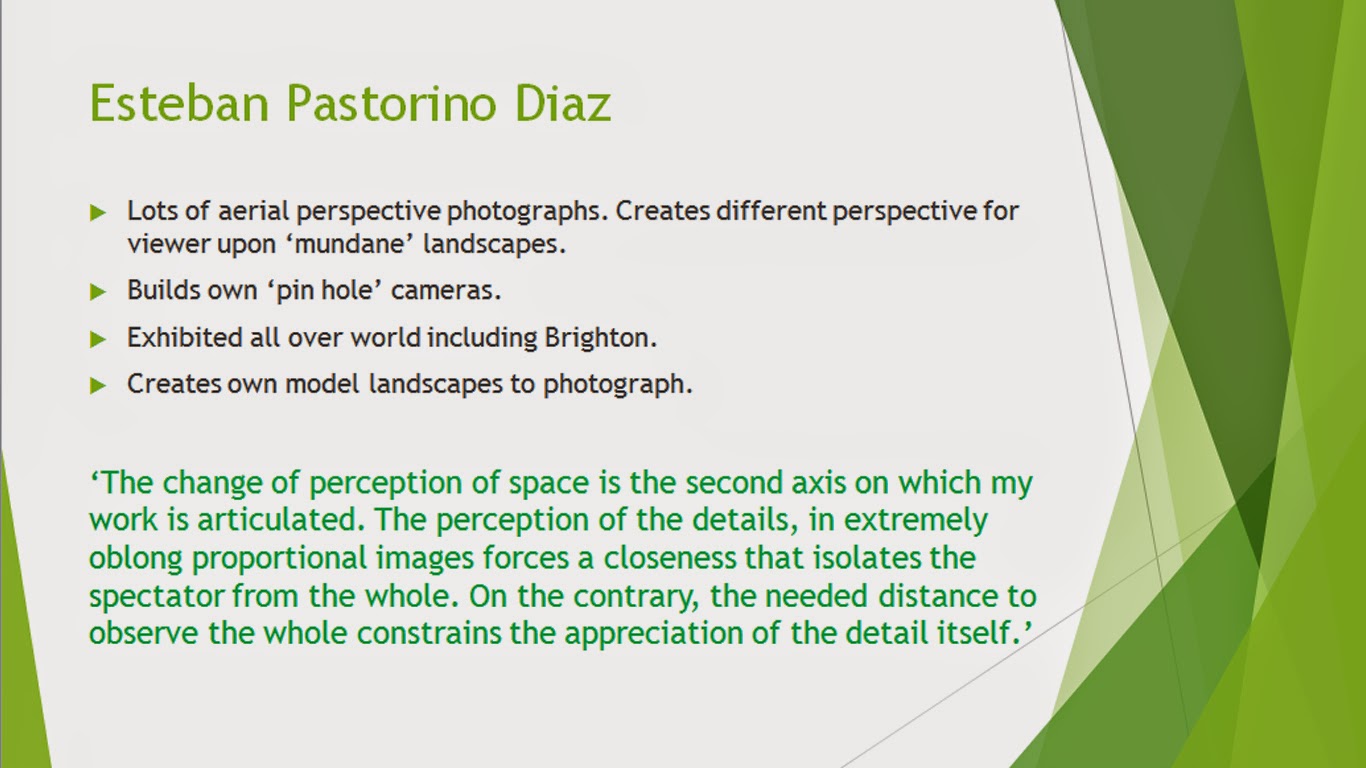
This is a screenshot from a student presentation. Analysing the psychology behind 'viewing' gives a reason for why photographers create cultural imaginaries. It suggests that the photographer may look at a subject in a different way to another person therefore will reflect their perspective through their photograph. This then allows the viewer to see from their point of view.

Esteban Pastorino Diaz


Diaz creates cultural imaginaries through his use of model landscapes. By physically creating the landscape he is able to portray a more accurate portrayal of his perspective.


The photo above denotes rows of identical houses across a lawn, which seems to represent a suburban lifestyle. Diaz' use of the tilt-shift effect makes the houses look much smaller but also draws attention to the houses in the front row. I like the use of bright colours and high contrast as it makes it look surreal.

Lauren Marsolier


Lauren Marsolier combines different photographs to create a new landscape. She explains that they are meant to reflect an unknown place.


The photograph above denotes a single house placed within a mountainous setting. I like the gradient of colours in the sky and the faded tones of the mountains, as I think this connotes a dream-like setting. This contrasts with the quite bright colours in the foreground, which makes it look unnatural and fantasy like.

Although I am fond of these photographers' work, I think for my own project I would prefer to document what is really there rather than creating my own landscape.


Friday, 27 February 2015

Photoshop practice


This photograph denotes an imaginary landscape, whereby the Disney Castle is in Brighton. I used Photoshop to place the Disney Castle on Brighton seafront, replacing the big wheel. I also used the replace colour tool and an adjustment gradient layer to make it look like there was a sunset.

I don't think I will use this technique in my final project because I would like to make my pictures look more natural. However I will use Photoshop techniques such as adjusting the contrast and converting to black and white.

Tuesday, 24 February 2015

Project Pitch

For my project I've decided to investigate the representation and identity of individuals through the use of Shop Windows. I think it's interesting that shops design their windows in elaborate ways in order to draw potential customers in. The shop windows themselves say quite a lot about the shop they're promoting, which speaks volumes about our capitalist society. Furthermore I would like to pay attention to the customers who walk by or enter the shops. I would like to leave my photographs ambiguous and leave it up to the audience whether they show either a positive or negative representation of the community.


Test shot: The photograph above shows different customers of The Disney Store. I was inspired by vernacular photography, whereby I wanted to document society the way it is rather than constructing the image. I was also inspired by the photographer Christopher Hue.

Representation in popular media:
In film and television, shopping is something that's usually associated with females, especially those who aren't very clever. This sometimes creates negative connotations.

Confessions of a Shopaholic (2009)


This movie is about a woman who is obsessed with shopping and ends up being in extreme debt. The screen captures above denote her being drawn to store windows as an adult and as a child.
"When I looked into shop windows I saw another world; a dreamy world full of perfect things."

Clueless (1995)


Cher's character in Clueless is also obsessed with shopping. It is meant to emphasise her air-brained personality and suggests that women who enjoy shopping are usually not very intelligent. In the screen shot above, Cher is in the middle of a crisis yet stops to look in a shop window. 

In my own photography I would like to subvert this stereotype that shopping is only something this stupid women enjoy, because in reality I think that all types of people engage in consumerist culture.

Monday, 23 February 2015

Brainstorm


When coming up with concepts for my project I first considered the representation of a person or collective group. I was inspired by the topic 'Otherness' and therefore wanted to explore groups who are misrepresented, such as women and/or ethnic minorities. This was also inspired by the exhibition I viewed called 'Human Rights Human Wrongs'. The downside to this is that I may be difficult to find people who would want to be photographed. Moreover it might be challenging to avoid stereotypes as some things might be considered offensive.

I also considered looking at a representation of a place instead. I prefer the pictures I've already taken of landscapes and objects in comparison to my photographs of people. One of my favourite pictures was the one of the Choccywoccydoodah shop window as I was able to capture depth of field. Subsequently I'd like to explore the representation of different shops.

Shop Task


Choccywoccydoodah in The Lanes, Brighton.


1. Head and shoulder shot of the man who worked at the till in the shop. I used the rule of thirds composition with this image and also tried to get some of the shop's merchandise within the background. I think this image would be better if there was more of a depth of field and if the foreground was more in focus.


2. Shot of barrister working. Again I think this picture would be better if it was focus more. It was difficult to capture him working but also being able to see his face.


3. Shot of a worker interacting with customers. I don't like this image because it is unclear what the focal point is. I didn't want to make the customers feel uncomfortable therefore I took the pictures from afar. However it ended up being not composed very well. 


4. A contextual shot of one of their famous cakes. I used a high ISO when taking this image in order to capture all the tiny details within the cake.