Friday, 27 February 2015

Photoshop practice


This photograph denotes an imaginary landscape, whereby the Disney Castle is in Brighton. I used Photoshop to place the Disney Castle on Brighton seafront, replacing the big wheel. I also used the replace colour tool and an adjustment gradient layer to make it look like there was a sunset.

I don't think I will use this technique in my final project because I would like to make my pictures look more natural. However I will use Photoshop techniques such as adjusting the contrast and converting to black and white.

Tuesday, 24 February 2015

Project Pitch

For my project I've decided to investigate the representation and identity of individuals through the use of Shop Windows. I think it's interesting that shops design their windows in elaborate ways in order to draw potential customers in. The shop windows themselves say quite a lot about the shop they're promoting, which speaks volumes about our capitalist society. Furthermore I would like to pay attention to the customers who walk by or enter the shops. I would like to leave my photographs ambiguous and leave it up to the audience whether they show either a positive or negative representation of the community.


Test shot: The photograph above shows different customers of The Disney Store. I was inspired by vernacular photography, whereby I wanted to document society the way it is rather than constructing the image. I was also inspired by the photographer Christopher Hue.

Representation in popular media:
In film and television, shopping is something that's usually associated with females, especially those who aren't very clever. This sometimes creates negative connotations.

Confessions of a Shopaholic (2009)


This movie is about a woman who is obsessed with shopping and ends up being in extreme debt. The screen captures above denote her being drawn to store windows as an adult and as a child.
"When I looked into shop windows I saw another world; a dreamy world full of perfect things."

Clueless (1995)


Cher's character in Clueless is also obsessed with shopping. It is meant to emphasise her air-brained personality and suggests that women who enjoy shopping are usually not very intelligent. In the screen shot above, Cher is in the middle of a crisis yet stops to look in a shop window. 

In my own photography I would like to subvert this stereotype that shopping is only something this stupid women enjoy, because in reality I think that all types of people engage in consumerist culture.

Monday, 23 February 2015

Brainstorm


When coming up with concepts for my project I first considered the representation of a person or collective group. I was inspired by the topic 'Otherness' and therefore wanted to explore groups who are misrepresented, such as women and/or ethnic minorities. This was also inspired by the exhibition I viewed called 'Human Rights Human Wrongs'. The downside to this is that I may be difficult to find people who would want to be photographed. Moreover it might be challenging to avoid stereotypes as some things might be considered offensive.

I also considered looking at a representation of a place instead. I prefer the pictures I've already taken of landscapes and objects in comparison to my photographs of people. One of my favourite pictures was the one of the Choccywoccydoodah shop window as I was able to capture depth of field. Subsequently I'd like to explore the representation of different shops.

Shop Task


Choccywoccydoodah in The Lanes, Brighton.


1. Head and shoulder shot of the man who worked at the till in the shop. I used the rule of thirds composition with this image and also tried to get some of the shop's merchandise within the background. I think this image would be better if there was more of a depth of field and if the foreground was more in focus.


2. Shot of barrister working. Again I think this picture would be better if it was focus more. It was difficult to capture him working but also being able to see his face.


3. Shot of a worker interacting with customers. I don't like this image because it is unclear what the focal point is. I didn't want to make the customers feel uncomfortable therefore I took the pictures from afar. However it ended up being not composed very well. 


4. A contextual shot of one of their famous cakes. I used a high ISO when taking this image in order to capture all the tiny details within the cake.


Thursday, 19 February 2015

The Photographers Gallery: Human Rights Human Wrongs


Today I went to visit The Photographers Gallery in London where they had an exhibition on called 'Human Rights Human Wrongs'. This was a collection of images which document various occasions where humans were treated unfairly such as police brutality during the civil rights movement.


I find the above quote inspiring as I believe in equality and that everyone should be treated fairly regardless of race, gender, sexuality, religion etc. I think that within my own photography I would like to focus on representing different types of people, especially minorities, such as black women.


http://thephotographersgallery.org.uk/human-rights-human-wrongs-3

http://www.standard.co.uk/goingout/exhibitions/human-rights-human-wrongs-the-photographers-gallery--exhibition-review-10044827.html?origin=internalSearch


Tuesday, 10 February 2015

Gender, Gaze and Otherness Photography

Otherness is defined as being different or differentiating from the dominant race.

Stuart Hall - The Spectacle of the Other


This was a slide from a student presentation. It uses a case study from Stuart Hall's 'The Spectacle of the Other'. Richard Dyer argues that black people are considered to be "other" and the actor/singer, Paul Robeson, is considered to be desirable because of this otherness. It is suggested that being black in this case is considered to be exotic, which is supposed by Alvarado's theory. Moreover, Robeson is either naked or nearly naked in the photographs, thus creating a fetish over his body. This representation is supported by Hall's argument that black men are objectified to something that is a fetish.

"In psychoanalysis, 'fetishism' is described as the substitute for the 'absent' phallus - as when the sexual drive becomes displaced to some other part of the body. The substitute then becomes eroticized, invested with the sexual energy, power and desire which cannot find expression in the object to which it is really directed" 

In the photographs of Robeson the penis is not directly shown because it is "forbidden", but its connoted signification is appealing to the audience. This fetish then emphasised with the use of a black model, who signifies the other.
This case study implies that photography becomes more interesting when using subjects of the "other" since their difference fascinates the viewer. It is implied that the average viewer is not meant to relate to the subject but instead reduce them to their differences and simply view them as something to look at.


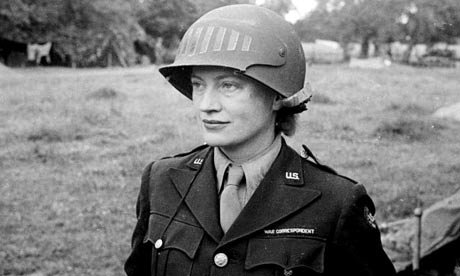
Lee Miller


Lee Miller was an American photographer who was active during the surrealism period from the 1920s. A lot of her work focuses on the binary opposition of men versus women.


The image above shows a woman in a stereotypically male role. The use of shallow focus makes connotes that she is important, which flouts the stereotype that men are inferior to women. Furthermore the woman appears to be looking away from the camera which makes the image look more natural rather than posed. Her facial expression connotes that she in determined. Altogether I think this image represents the topic of the other because it is a woman being represented in a way a man usually would be seen.

Nan Goldin


Nan Goldin's photography challenges stereotypical portrayals of gender and sexuality.

Nan Goldin ‘Misty and Jimmy Paulette in a taxi, NYC’, 1991
© Nan Goldin, courtesy Matthew Marks Gallery, New York

The photo above denotes two drag queens. The use of bright colours compliments their eccentric style whilst the use of muted tones connotes a sense of edginess thus emphasising that they are considered to be other.
In relation to this photograph Goldin states: "I was eighteen and felt like I was a queen too … they became my whole world. Part of my worship of them involved photographing them. I wanted to pay homage, to show them how beautiful they were."

Sarah Maple


Sarah Maple uses her photography to subvert the representations of gender, race, religion and so on.


In the above photo, Maple uses the character Snow White who is traditionally represented as a ditsy woman who exists to serve men. Maple subverts this representation of women by showing that she can be smart instead.
"I wanted to empower the princesses with the thought in mind that this would empower young girls."
I like the idea of using the other in photography in order to establish a relation between the subject and its audience. 

Diane Arbus

Diane Arbus was an American photographer who took pictures of people with abnormalities, representing them as "freaks".  Although it seemed harsh she thought that by using photography she had the power to represent these people in the most honest way. Throughout her life she suffered from depression and eventually commit suicide.


The picture above denotes twins looking directly into the camera. Their faces look different to many people since their ears are really large and protruding. Their direct address and facial expressions make them look intimidating. This emphasises the stereotype that different people are usually not socially excepted and that people are uncomfortable with them. The use of shadows across their faces  makes them look mysterious, again emphasising their otherness.

Portraits

In class today we experimented with portrait photography. We had the task of creating an exterior portrait of someone we know and someone we don't know.


Most of the images came out way too dark like the photograph above. I used the rule of thirds composition here, so I think it would have been successful if it wasn't so dark.


To combat the darkness,  I subsequently changed the camera setting to Auto without flash so that the images would be bright enough and not blurred. 


I used an extreme close up in the photograph above in order to focus on the subject's eyes. I like the shallow focus effect that was created here.

Although this task was effect in getting used to the Nikon D7000 camera and its settings, my images still lack the punctum that would engage the audience. I will try to create more interest in my subsequent photo shoots.